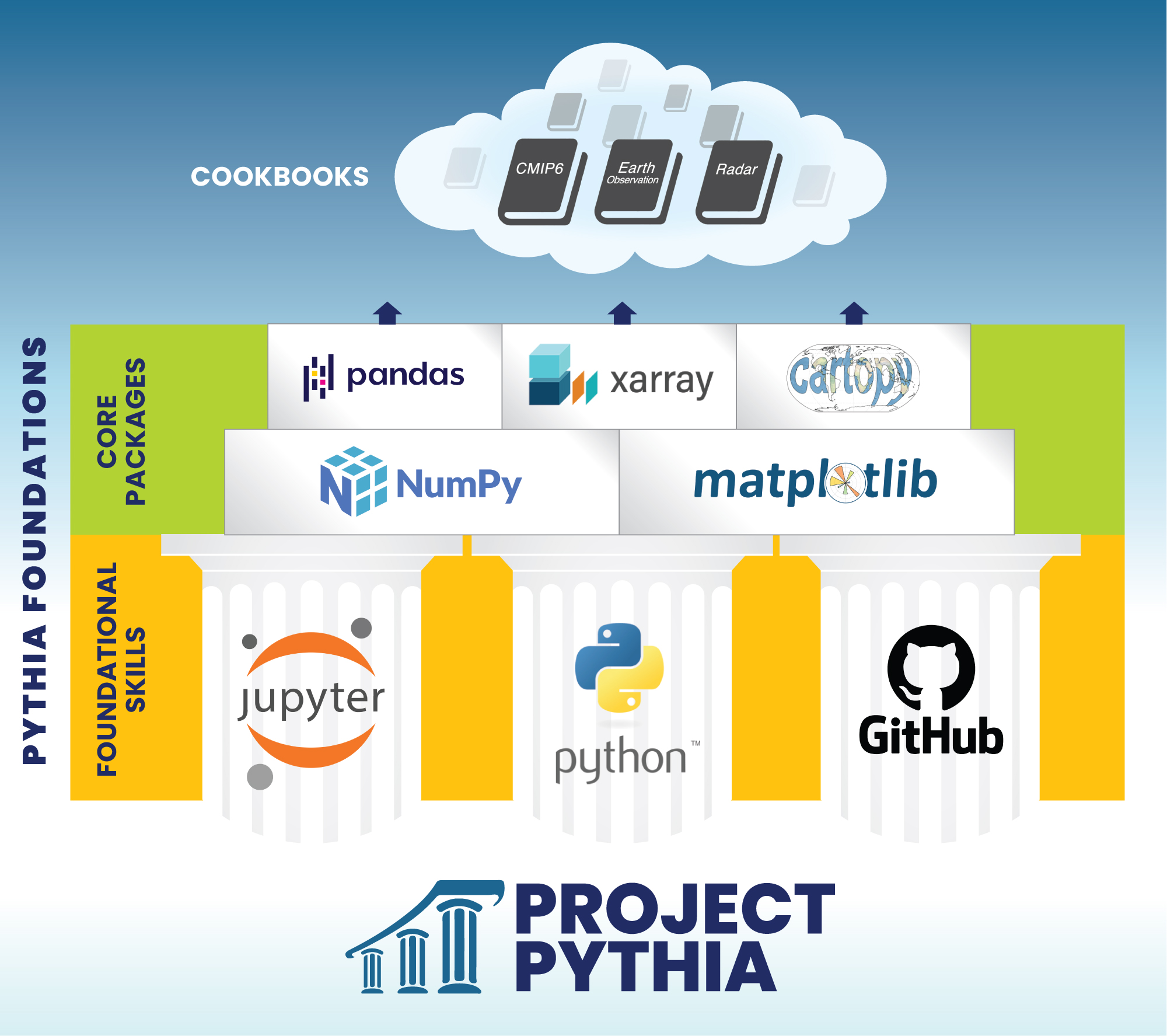
This Foundational Skills section of the book contains cross-referenced tutorial material for computing skills that one needs in order to work effectively with the open-source Scientific Python stack.
Familiarizing yourself with these topics first will allow you to get the most out the Python-specific material in the Core Scientific Python Packages section of the book!
Roadmap
This section starts with a discussion about why we use the Python language. From there, our Zero to Python quickstart guide gives an interactive tour of Python for those migrating from other programming languages, followed by a detailed installation guide showcasing some different ways to install the necessary software and run Python code on various platforms.
We then turn our attention to the Jupyter ecosystem, a set of tools for interactive and reproducible computing that is very widely used in the geosciences. This includes a tutorial on running and editing notebooks in JupyterLab, which is our recommended way to interact with most of the content in Pythia Foundations and the Pythia Cookbooks.
Finally we offer a comprehensive set of tutorials on git and GitHub, including how to get started with a free GitHub account (and why you would want to), how to make use of GitHub’s collaboration features like Issues and Discussions, an introduction to version control with git, and more!
The ultimate goal of the GitHub section of the book is to empower you, the reader, to make your own contributions to open source projects through Pull Requests on GitHub, including specific guidance on making contributions to Project Pythia.
Fork away!
Topics
Why Python?: A brief preamble about Python’s distinguishing features.
Getting started with Python: A quickstart Python example, followed by detailed tutorials on how to install and run Python on your own system.
Getting started with Jupyter: All about the Jupyter ecosystem, which provides tools and environments for interactive, reproducible computing with Python.
Getting started with GitHub: Learn about the collaboration tools (GitHub) and version control software (Git) that enable the open-source community.